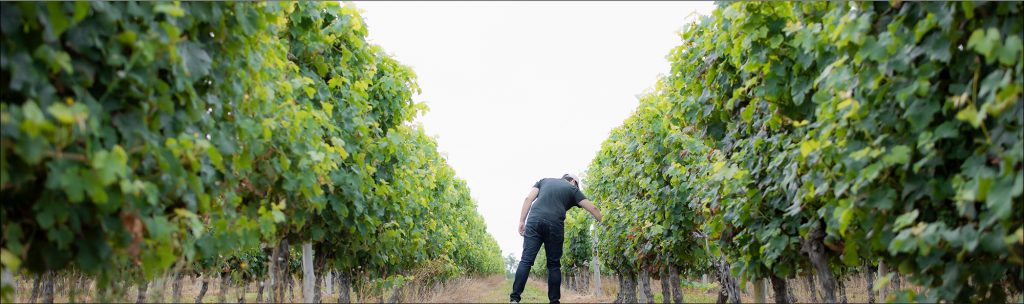
Baco, also called Baco 22A or Baco Blanc, is a white hybrid grape created in 1898 by François Baco, a schoolteacher from the Landes area of southwest France, who crossed Folle Blanche with Noah, a hybrid of American vine species. Today it is the only hybrid grape listed as a full member of a French AOC (protected designation of origin): Armagnac. On the tawny sands of Bas-Armagnac, it makes round, fruit-driven brandies that show their full depth after long aging in oak.
Where does the Baco grape come from?
In the late 19th century, phylloxera, a tiny insect from North America, devastated the vineyards of Gascony. Folle Blanche, the historic Armagnac grape, was replanted on American rootstocks but became more fragile, especially against rot. Growers needed a sturdier vine that still made good wine for distilling.
François Baco (1865–1947), a schoolteacher in the village of Bélus who spent much of his life breeding vines, provided one. In 1898 he selected a cross between Folle Blanche, a European Vitis vinifera grape, and Noah, a hybrid of American species. The goal: keep Folle Blanche’s qualities for brandy while gaining the hardiness of an American parent.
What does “22A” mean?
It is a selection code. France’s inventory of intangible cultural heritage, in its entry on Armagnac, explains it as the 22nd vine in row A, picked from many trials. The grape was also known as “Maurice Baco,” after its creator’s late son. Official texts now simply call it “baco blanc.”
Why is Baco unique among French appellations?
In grape growing, a hybrid is a cross between the European vine and one or more American species. France planted many hybrids after phylloxera, then gradually excluded them from its appellations, which were reserved for European grapes.
Baco is the exception because it became part of Armagnac’s identity. For much of the 20th century, until the late 1970s, it was Armagnac’s leading grape. The appellation’s official rules still describe it, alongside Ugni Blanc, as one of Armagnac’s “major” grapes.
Scheduled to disappear, then kept
Its future was not always secure. In the early 1990s, INAO, the French body that oversees appellations, planned to phase it out: Baco vines were to be pulled up around 2010. Growers, especially in Bas-Armagnac, defended a grape suited to their soils and central to their brandies. When the appellation rules were revised in 2005, Baco was kept and officially listed among the authorized grapes. It is still in the current rulebook, approved in March 2025.
One nuance, for the sake of accuracy: in recent years INAO has let appellations trial new varieties, including some newly bred disease-resistant hybrids such as Voltis in Champagne. Those remain experimental, time-limited and capped at a small share of vineyards and blends. Baco, by contrast, is a full member of the Armagnac grape list, with no deadline and no cap.
Why does Baco thrive on the tawny sands of Bas-Armagnac?
In the west of the appellation, Bas-Armagnac sits on the sables fauves, or tawny sands: a marine deposit of clay and silica, tinted by iron oxides. These light, acidic soils carry boulbènes, fine silty to sandy-silty earth. The climate is oceanic, with steady rain all year.
The appellation rules describe Baco as “very well suited” to sandy and boulbène soils, while it does far less well on the limestone of the east. On these sands it brings several advantages:
- Hardiness: less prone to gray rot than Folle Blanche, it needs fewer vineyard treatments than Armagnac’s other grapes.
- Consistency: vigorous and fertile, it gives steady, generous crops, which is what distilling wines call for.
- A wine built for the still: low in alcohol and high in acidity, it keeps naturally until distillation and concentrates its aromas in the spirit.
The soil differences between west and east are covered in our guide to the three Armagnac regions.
What flavors does Baco bring to Armagnac?
Each grape leaves its mark. Folle Blanche gives fine, floral brandies; Ugni Blanc brings freshness and finesse; Colombard adds fruity, spicy notes. Baco contributes roundness and ripe-fruit aromas, which come forward mostly with age.
Our single-vintage, 100% Baco Armagnacs show that arc clearly. The youngest offer apricot, spice and fresh fruit. The oldest move toward prune, blond tobacco, cocoa, mellow oak and a noble rancio, the complex, evolved note found in very old brandies. The texture broadens and the finish lengthens.
Is Baco made for long aging?
Yes, it is one of its best-established strengths. The French heritage inventory entry on Armagnac highlights its aptitude for aging. A low-alcohol, high-acid Baco wine yields a spirit rich in aromas, with plenty to develop in contact with oak.
In the barrel, the brandy slowly oxidizes, partly evaporates and draws color and new aromatic compounds from the wood. Over the decades, a Baco brandy grows rounder and more complex. At our estate, our 100% Baco vintages go back as far as 1941.
How important is Baco in Armagnac today?
The Armagnac AOC allows ten grapes: Baco Blanc, Blanc Dame, Colombard, Folle Blanche, Graisse, Jurançon, Mauzac, Mauzac Rose, Meslier Saint-François and Ugni Blanc. Four dominate: Baco and Ugni Blanc, neck and neck (35% and 33% of plantings in 2024, according to the Armagnac trade body), then Colombard (12%) and Folle Blanche (4%), now rare.
Long under threat, Baco has regained its place: it now shares the top spot with Ugni Blanc, which adapts to every terroir in the appellation. Bas-Armagnac is still its home ground. Some producers state “100% Baco” on their labels.
Why Cloud & Clet chose 100% Baco
Our family estate lies in Mauléon-d’Armagnac, in the heart of the Grand Bas-Armagnac. Its 120 hectares (about 300 acres) of vines, woods, heathland and meadows rest on tawny sands. We grow Armagnac’s four main grapes: Baco, Ugni Blanc, Colombard and Folle Blanche.
For our long-aged brandies, the choice is clear: our VSOP, XO, Hors d’Âge and every vintage are 100% Baco. On our sands this grape is at home, and it reveals its roundness in the barrel, over time. We handle every step: vineyard, winemaking, distillation on site in our own Armagnac column still, aging in oak casks in semi-underground cellars, blending and bottling.
- VSOP, at least 6 years: morello cherry, gingerbread, oaky vanilla, then orange zest, cinnamon and blond tobacco; supple and round.
- XO, at least 10 years: candied mandarin, orange zest, dried fruit; broad palate, mellow oak, long finish.
- Hors d’Âge, from lots aged 15 years and more: ripe apricot, cinnamon, vanilla; round and powerful, with prune and blackberry.
- Vintages from 1941 to 2016: a single harvest, never blended, bottled to order.
Frequently asked questions
Is Baco a GMO?
No. Baco came from a conventional cross between two vines, by pollination, in 1898. No genetic engineering is involved.
Is Baco still allowed in Armagnac?
Yes. Baco Blanc is one of the ten grapes in the current Armagnac AOC rules, with no phase-out date.
Is Baco Blanc the same as Baco Noir?
No. Baco Noir is another hybrid bred by François Baco, a dark-skinned grape grown mainly in North America for red wine. It is not permitted in Armagnac; only Baco Blanc, or Baco 22A, is.
Is a 100% Baco Armagnac better than a blend?
It is a question of style, not rank. A 100% Baco Armagnac puts the grape’s roundness and ripe fruit up front; a blend plays on contrast, for example with the floral finesse of Folle Blanche or the freshness of Ugni Blanc.
Born of the phylloxera crisis and kept alive by the growers of Bas-Armagnac, Baco is a grape best judged over time. Comparing a VSOP with an old vintage shows what the years bring to it. To see where it grows, explore our estate.

