Store Armagnac upright, away from light and heat. An unopened bottle keeps almost indefinitely as long as you keep an eye on the cork; an opened bottle is best enjoyed within one to two years, sooner if it is nearly empty. And unlike fine wine, Armagnac does not improve in the bottle.
Should you store Armagnac upright or on its side?
Upright, always. It is the opposite of wine, and for good reason.
Wine bottles are laid down to keep the cork moist and tight. Armagnac is at least 40% ABV, and constant contact with such concentrated alcohol eventually damages cork: it can soften or crumble, give the spirit a corky taste and stop sealing properly. Standing upright, the cork only touches vapor, and the spirit stays intact.
Some collectors briefly tip their bottles once or twice a year to moisten the cork and keep it from drying out. That is optional if you check the cork regularly.
Where to store Armagnac: light, heat and humidity
Keep it in the dark
Light, especially sunlight, slowly fades a spirit’s color and aromas. A bottle displayed on a shelf by a window will eventually lose its edge. The original box or tube, a closed cabinet or a cellar are the best places for it.
Keep it cool and steady
Heat speeds up evaporation and stresses the cork: the liquid expands and contracts, and the seal suffers. Avoid the top of a radiator, the space next to an oven or a sunny window, and the trunk of a car. A cool room with a steady temperature is perfect; you don’t need a wine fridge.
Mind the humidity
A very damp cellar won’t hurt the Armagnac itself, but it can ruin labels and capsules, which may mold or peel. For a collector’s bottle or a gift, the label matters.
The fridge is pointless for aged Armagnac. Only Blanche, served ice-cold, belongs there, or even in the freezer: at 40% ABV, it won’t freeze at home-freezer temperatures.
Does Armagnac age in the bottle?
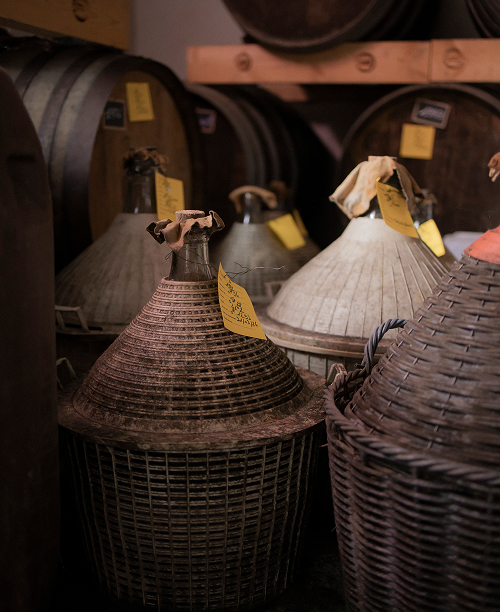
No. It is the most common question, and the answer from the Armagnac trade body is clear: Armagnac needs wood to age. Its evolution comes from exchanges with the oak cask and slow oxidation through the wood. Glass is inert. In the cellars, very old spirits are sometimes transferred into demijohns, large glass carboys, precisely to stop the influence of the wood. At our estate, the spirit ages in oak casks in semi-underground cellars (see our craft).
In practical terms, an Armagnac’s age is the time it spent maturing before bottling, not how long the bottle has sat on a shelf. An XO bought twenty years ago is still an XO; it hasn’t aged in your cabinet (our guide to age statements explains each category). For a vintage, the year on the label is the harvest year; if the label also gives a bottling date, it helps you gauge how long the spirit matured.
How long does an unopened bottle of Armagnac last?
Almost indefinitely. The Bureau National Interprofessionnel de l’Armagnac (BNIA), the appellation’s trade body, sets just one condition: check the cork, or replace it, every five to ten years.
Warning signs to watch for:
- a level that drops noticeably, meaning air is getting in and the spirit is evaporating;
- drip marks or a smell of alcohol around the capsule;
- a cork that is dry, cracked, crumbly or spins in the neck.
How long does Armagnac last once opened?
Once opened, a bottle of Armagnac is best enjoyed within one to two years, according to the BNIA. Air entering the bottle causes oxidation, however slight, that eventually changes the taste. The most delicate notes, fruit and flowers, fade first; the spirit can taste flatter, or the alcohol more prominent. The loss is most noticeable in old vintages, whose appeal lies precisely in their finesse and complexity.
Fill level changes everything
The more air in the bottle, the faster the oxidation. A barely opened bottle easily lasts the one-to-two-year window; a bottle down to its last third changes much faster.
| Fill level | What happens | What to do |
|---|---|---|
| Nearly full | Little air, slow change | Close tightly; one to two years as a guide |
| Half full | As much air as spirit, faster oxidation | Aim for the shorter end, or decant |
| Under a third | Lots of air, aromas fading | Decant into a small bottle |
Decant into a smaller bottle
Once the bottle is half empty, the best fix is to cut down the air. Pour the Armagnac into a smaller bottle, filled almost to the top:
- glass, clean and completely dry, never plastic;
- the right size: 100 ml, 200 ml or a 375 ml half bottle, depending on what is left;
- with an airtight closure: a screw cap with a liner, or a new bar-top cork;
- labeled with the name, age or vintage, and opening date.
Then store it like the original bottle: upright, cool and in the dark.
Which cork for an Armagnac bottle?
Armagnac bottles are often sealed with a bar-top cork: a cork shank topped with a wooden, glass or synthetic head, which you pull out and push back in by hand.
- Tired cork: if it is dry, cracked or loose, replace it with a new bar-top cork of the same diameter, easy to find online or in specialty shops.
- Broken or crumbling cork: remove the pieces carefully, then strain the spirit through a plain paper coffee filter or a clean cheesecloth before rebottling.
- Wax or capsule: trim wax away with a knife, making sure no chips fall into the neck.
Old vintages and bottled-to-order Armagnac
An old vintage needs the same care, with extra attention to the cork. On a bottle filled decades ago, it is often the weak point: open it slowly, with a twisting motion, and keep a spare cork at hand. Upright, in its box, away from light, the bottle will keep for years without losing what makes it special.
At Cloud & Clet, our vintages, from 1941 to 2016, are 100% Baco Bas-Armagnacs from a single harvest, aged in oak casks in our cellars and bottled to order. The bottle and its cork are therefore brand new when they leave the estate. Given for a birth year (see our article on vintage Armagnac as a birth-year gift), such a bottle can wait years before being opened: it won’t gain anything in glass, but it will stay intact if kept upright, cool and out of the light, with its cork checked now and then.
Armagnac storage at a glance
- Bottle upright, never on its side.
- Out of the light: box, tube or closed cabinet.
- Cool and steady, away from radiators and windows.
- Unopened: keeps almost indefinitely; check the cork every five to ten years.
- Opened: one to two years, tightly closed after each pour.
- Half empty or less: decant into a small glass bottle filled to the top.
- No aging in the bottle: there is nothing to gain by waiting.
- No long-term storage in a crystal decanter.
Frequently asked questions
Does Armagnac go bad?
Not in the food-safety sense. EU labeling rules exempt drinks of 10% ABV or more from a best-before date, which is why you won’t find one on a French bottle. An opened bottle kept too long can, however, lose its aromas.
Can you keep Armagnac in a crystal decanter?
For serving, yes. For weeks or months, no: lead crystal can release lead into spirits stored in it for long periods, as analyses published in the early 1990s showed. A lead-free decanter avoids that issue but rarely seals tightly, so the original bottle remains the best container.
The level in my sealed bottle has dropped. Is it ruined?
Not necessarily. A slight drop can appear over decades. If it is significant, the cork is no longer tight: replace it, then taste the spirit to judge its condition.
Should an opened bottle go in the fridge?
No. A cool, dark cabinet is enough, and aged Armagnac is served at room temperature. Only Blanche, served ice-cold, can live there for convenience.
Store it well, taste it well
Stored with care, a bottle of Armagnac will cross the years without fading. When the day comes, our guide on how to taste Armagnac covers the glass, the temperature and every step of the tasting.