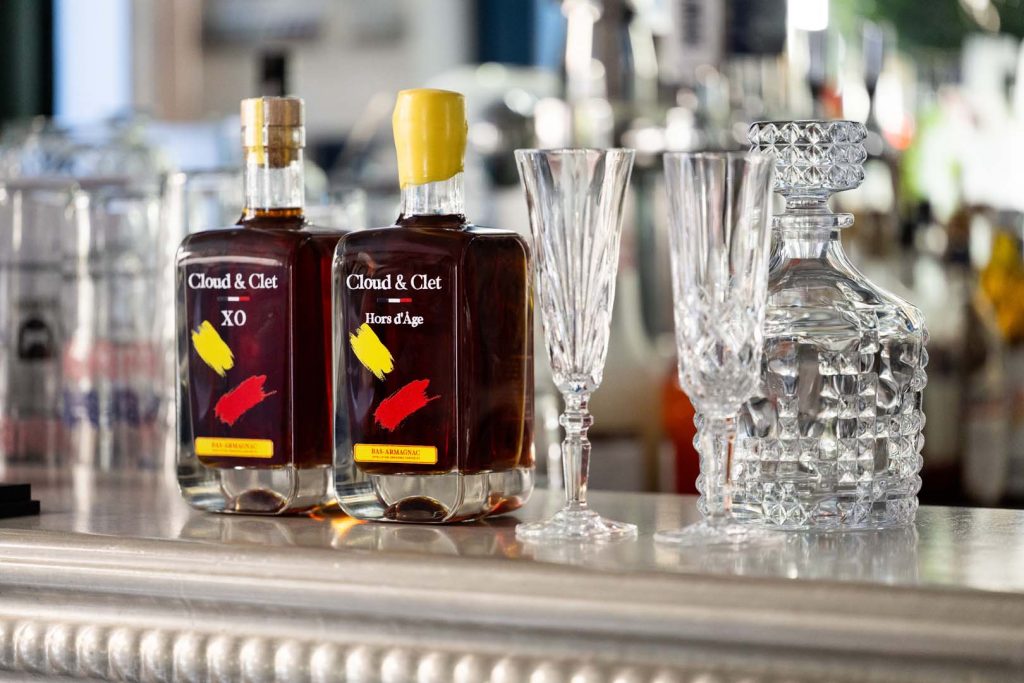
On an Armagnac label, VS, VSOP, XO and Hors d’Âge state the minimum age of the youngest brandy in the blend: at least 1 year in oak for a VS, 4 years for a VSOP, 10 years for an XO or Hors d’Âge. A vintage Armagnac comes from a single harvest, and its year is printed on the bottle. Here is what each term guarantees, and what it leaves out.
Armagnac age statements at a glance
| Label term | Minimum age of the youngest brandy | Age account |
|---|---|---|
| Blanche Armagnac | Unaged: at least 3 months of rest in neutral containers | — |
| VS or *** (three stars) | 1 year in oak | Compte 1 |
| VSOP | 4 years | Compte 4 |
| Napoléon | 6 years | Compte 6 |
| XO | 10 years (6 years before April 2018) | Compte 10 |
| Hors d’Âge | 10 years | Compte 10 |
| “15 years,” “20 years”… | The stated age | Matching compte |
| Vintage | A single harvest; at least 10 years according to the trade body | Tracked separately |
Sources: BNIA (the Armagnac trade body), the official Armagnac specification, French regulations of March 14, 2007, and December 16, 2016.
What is an age account?
The compte d’âge, or age account, is the system used to track and verify how long each brandy has spent in oak. It is set out in a French regulation of March 14, 2007, and kept by the BNIA.
- Compte 00: the new spirit, from the day it is distilled until the following March 31. Distillation must be finished by March 31 of the year after the harvest.
- Compte 0: from April 1, the brandy resting in oak.
- Compte 1, 2, 3…: every April 1, all brandies in barrel move up one account.
Take a brandy from the 2015 harvest, distilled over the winter. It enters compte 0 on April 1, 2016. It can go into a VS from April 1, 2017, into a VSOP from April 1, 2020, and into an XO or Hors d’Âge from April 1, 2026.
For blends, the rule is simple: the blend takes the account of its youngest brandy. A blend of 30-year-old and 4-year-old brandies stays in compte 4. And the clock only runs in the barrel: once bottled, Armagnac no longer changes, as the BNIA points out.
VS or three stars: at least 1 year
VS stands for “Very Special.” A VS, or three-star (***) Armagnac, blends brandies whose youngest has spent at least one year in oak. That is also the minimum for any aged Armagnac under the appellation rules. A VS is therefore a young Armagnac, showing fresh fruit and oak, and often used in cocktails and highballs.
VSOP: at least 4 years
VSOP stands for “Very Superior Old Pale.” The youngest brandy in the blend has at least four years in oak. Over that time, the oak integrates, the color deepens and the aromas start moving toward cooked fruit and spice.
XO and Hors d’Âge: at least 10 years
XO stands for “Extra Old.” Since April 1, 2018, an Armagnac can carry this term only if its youngest brandy is at least 10 years old; the minimum used to be 6 years. Bottles packed before that date could be sold until stocks ran out, so an older XO bottle may follow the old rule.
Hors d’Âge (“beyond age”) has the same 10-year minimum. Legally, the two terms are equivalent; which one a house uses is a matter of tradition. The trade body notes that the real average age of an Hors d’Âge is always higher than that minimum, which is often well exceeded.
Napoléon, Réserve, Extra: the other terms
Other terms show up on some labels. Napoléon means at least 6 years in oak for the youngest brandy. Réserve, Vieille Réserve and Extra also appear; their thresholds fall under France’s general rules for grape brandies and are not part of the trade body’s simplified chart. Since 2010, the Armagnac trade has been working to simplify its age categories. When you see one of these terms, an age stated in years remains the clearest guide.
Age stated in years: “10 years,” “20 years”…
An Armagnac can also show a specific age. As with an age statement on a bottle of whiskey, the number always refers to the youngest brandy in the blend. A “20 years” contains nothing younger than 20 years in oak, but it may hold much older brandies. That tells you more than an XO or Hors d’Âge, which only guarantee 10 years.
Vintage Armagnac: a single harvest
The Armagnac trade body calls vintages an Armagnac specialty. The year on the label is the year the grapes were picked. The brandy must not have been blended with other vintages or moved into an age account, and its records must back that up. According to the BNIA, a vintage Armagnac is released only after at least 10 years of aging.
Because Armagnac ages only in the barrel, the bottling date matters as much as the harvest year. A 1980 vintage bottled in 2000 spent about twenty years in oak; bottled in 2020, about forty. When the bottling date appears on the label, it tells you the real age. To pick a specific year, see our guide to giving a birth-year vintage Armagnac.
Minimum age vs. actual age: what the label really says
An age statement is a floor, not an average. A VSOP may contain 10- or 15-year-old brandies, as long as the youngest has at least 4 years. Two XOs can therefore be very different: one built around 10-year-old brandies, another around 25-year-old ones. The cellar master assembles each blend by tasting, according to the house style. Some producers disclose the age of their blends on the label or tech sheet, which is the most useful information for comparing bottles.
Ages in the Cloud & Clet range
At the Domaine de M., in Mauléon-d’Armagnac, our Armagnacs age in oak barrels in partly underground cellars. Here is how our range compares with the legal minimums:
| Expression | Legal minimum | Cloud & Clet |
|---|---|---|
| Blanche | Unaged | Unaged |
| VS | 1 year | At least 3 years in French oak |
| VSOP | 4 years | At least 6 years, 100% Baco |
| XO | 10 years | At least 10 years, 100% Baco |
| Hors d’Âge | 10 years | Lots aged 15 years and more, 100% Baco |
| Vintages | A single harvest | Single-harvest Bas-Armagnacs, 100% Baco, unblended |
Our VSOP goes two years beyond its category minimum, and our Hors d’Âge at least five. Our vintages, the oldest dating back to 1941, are aged in oak in our cellars and bottled to order.
How does Cognac compare?
Cognac uses the same main terms with similar thresholds: 2 years for a VS, 4 for a VSOP, 6 for a Napoléon, 10 for an XO or Hors d’Âge, and 14 for an XXO. The main gap is the VS. For the other differences, read Armagnac vs. Cognac: What’s the Difference?
Frequently asked questions
Does Armagnac keep aging in the bottle?
No. Aging happens in oak. Once bottled, Armagnac no longer changes: it keeps the age it had when it was bottled.
What is the difference between XO and Hors d’Âge?
Legally, none: at least 10 years for the youngest brandy in both cases. The choice of name is up to each house.
Why do some sources say a VS must be 2 years old?
That is the Cognac rule. For Armagnac, the trade body sets at least 1 year in oak for a VS or three-star.
What do “compte 4” and “compte 10” mean?
The number is the count of years spent in oak, starting on the April 1 after distillation. Compte 10 covers brandies with at least 10 years in barrel.
Is a vintage older than an Hors d’Âge?
Not necessarily. A vintage shows the harvest year; its age depends on how long it spent in oak before bottling. An Hors d’Âge blends brandies whose youngest is at least 10 years old.
Reading an Armagnac label comes down to three points: the term sets a minimum, that of the youngest brandy; only time in oak counts; a vintage tells the story of a single year. See how these rules apply across our full range, from Blanche to vintages.

