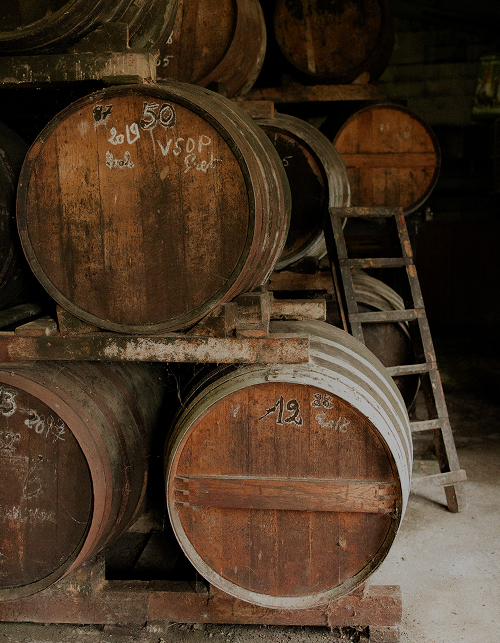
If you want to give a bottle from someone’s birth year, vintage Armagnac is the natural choice: in Gascony, bottling a single harvest is a long-standing tradition, and vintages span many decades. Before you buy, it helps to know what the year on the label guarantees, and to look for a second date, the bottling date, which tells you how long the brandy actually spent in oak.
Why is Armagnac the go-to spirit for vintages?
Most aged brandies are blends: cellar masters marry casks of different ages to keep a consistent house style. Armagnac blends too, but it has another tradition. Its official appellation rules note that Armagnacs are sometimes vintage-dated, a long-standing and common practice in the region, and the BNIA, Armagnac’s trade body, describes the vintage as an Armagnac specialty.
Cognac rules allow vintages as well, but they remain rare; the Cognac tradition is built on blending. In Armagnac, the cellar master decides, lot by lot, which brandies go into blends and which are kept back as vintages. The spirit suits the exercise: distilled to a relatively low strength (72.4% ABV at most off the still), Armagnac keeps a lot of aromatic character, enough for a single year and its casks to show through.
What does a vintage date guarantee?
On a bottle of Armagnac, the year is not decoration. It commits the producer on several points.
- A single harvest. The year is the grape harvest. All the brandy in the bottle comes from it, with no blending across years.
- Prompt distillation. Under appellation rules, distillation must be finished by March 31 of the year after the harvest. A 1975 was therefore distilled over the winter of 1975–76.
- A minimum age. According to the BNIA, a vintage Armagnac must be at least ten years old.
- Tracked stocks. Vintage tracking and age controls are governed by a French regulation specific to Armagnac; producers must be able to document the year of each lot.
What the year does not tell you is how long the brandy stayed in the barrel. For that, you need another date.
Why the bottling date matters
Armagnac ages in oak. Through contact with the wood and the air that slowly passes through it, it gains color (from pale yellow to orange, amber, then mahogany), softens, and develops notes of candied fruit, spice, and eventually rancio, the complex bouquet of very old brandies. Some of it evaporates every year: the angels’ share.
In the bottle, all of that stops. Glass is inert, so Armagnac no longer changes once bottled. A vintage’s real age is the time it spent in wood, not the number of years since the harvest.
A 1975 bottled in 1990 vs. a 1975 bottled today
Picture two bottles with the same year. The first was bottled in 1990: its brandy spent about fourteen years in oak, then froze in time. Opened today, it has the profile of a fifteen-year-old Armagnac, livelier and fruitier, even though the label says 1975.
The second stayed in the barrel until it was bottled today. It had half a century to concentrate, absorb its oak, and develop the rancio of very old brandies. Same year, two very different spirits: the vintage tells you where the Armagnac comes from; the bottling date tells you how far it has traveled.
One nuance: some houses move their oldest brandies into large glass demijohns (dames-jeannes) after several decades to halt their development. The principle is the same: only time in wood counts.
How to tell
- Look for the bottling date on the front or back label; many producers print it. If it’s missing, ask the seller.
- For an older bottle bought at auction or from a collector, also check the fill level and the condition of the cork: after decades, storage conditions matter.
- Bottling to order settles the question: the brandy waited in the cellar, not on a shelf.
How to choose the right vintage
The year comes first; it is what gives the gift its meaning. But age shapes flavor, so it helps to know what to expect. The guide below describes how Armagnac generally evolves in oak; each vintage keeps its own personality.
| Time in oak | General profile |
|---|---|
| About 10 to 20 years | Gold to orange color, fresh fruit, floral and oak notes, lively, warming palate |
| 30 to 40 years | Amber color, cooked or candied fruit, spice, better-integrated oak, rounder palate |
| 50 years and more | Mahogany color, rancio, dried fruit, great depth, long finish |
In our cellars, the youngest vintages show apricot, spice, and fresh fruit; the oldest develop a noble rancio with notes of prune, blond tobacco, cocoa, and mellow oak.
Think about the person receiving it, too. Someone new to Armagnac will often appreciate the liveliness of a younger vintage; a lover of old spirits will look for the depth of the older years. And if the birth year isn’t available, another date can mean just as much: the year a couple met or married, or the year someone moved into a new home.
Occasions for a vintage gift
A vintage is a dated gift: it ties a bottle to a specific year in someone’s life.
- A milestone birthday: 40, 50, 60 or beyond, with the vintage of the birth year.
- A wedding anniversary: the year of the wedding; for a golden anniversary, a fifty-year-old vintage.
- A retirement: the birth year, or the year the person started their career.
- A birth: that year’s vintage won’t be available for at least ten years. You can give the parents the vintage of their own birth year, or of the year they met.
Because Armagnac doesn’t change in the bottle, there’s no need to open it right away: stored properly, it can wait for whatever moment its owner chooses.
Presenting and storing the gift
A short note with the bottle gives it its full meaning: the harvest year, the grape, the estate and, if known, the bottling date. The recipient will know exactly what they are holding.
Store the bottle upright, so the spirit isn’t in constant contact with the cork, away from light and big temperature swings. Once opened, close it tightly after each pour: the lower the level, the more the air in the bottle affects the brandy. Our guide on how to store Armagnac covers the details.
An old vintage is served neat, at room temperature, in a stemmed tulip glass, after a few minutes in the glass to open up. More in our guide on how to taste Armagnac.
Cloud & Clet vintages, 1941 to 2016
Cloud & Clet comes from Domaine de M., a family estate in Mauléon-d’Armagnac, in the heart of the Grand Bas-Armagnac. On its tawny sands (sables fauves), the estate grows its grapes, makes the wine, distills on site in its own Armagnac column still, then ages the brandy in oak casks in semi-underground cellars.
Our vintages are 100% Baco Bas-Armagnacs, from the grape bred in 1898 by Landes ampelographer François Baco. Each comes from a single harvest, unblended, and they span 1941 to 2016. Every one is bottled to order: the brandy waits in our cellars, not on a shelf, until you choose your year. Since each bottle is prepared for you, it’s wise to order a little ahead of the date.
Each vintage has its own page, and the address follows the year: /en/gammes/vintages/bas-armagnac-1975-vintage/ for 1975, for example. See the 1966 Bas-Armagnac, the 1976 Bas-Armagnac or the 1986 Bas-Armagnac.
Frequently asked questions
Does vintage Armagnac keep aging in the bottle?
No. Armagnac stops changing once bottled. Its age is the time it spent in oak, which is why the bottling date matters.
Is the year on the label the distillation year?
No, it’s the harvest year. Distillation follows within months, by March 31 of the next year at the latest.
Can I find a vintage from a recent birth year?
Not yet: a vintage must be at least ten years old before it can be sold.
What’s the difference between a vintage and a Hors d’Âge?
A Hors d’Âge is a blend of several years; the term refers to the minimum age of the youngest brandy in the blend. A vintage comes from a single harvest and carries its year. Our Hors d’Âge brings together lots aged 15 years and more.
In short
Giving a vintage Armagnac comes down to two dates: the harvest year, which gives the gift its meaning, and the bottling date, which tells you its true age. Every available year is on our vintage Bas-Armagnacs page.