Armagnac and Cognac are both French brandies made from white wine, protected by an appellation of origin and aged in oak. What sets them apart is where they come from (Gascony for Armagnac, the Charentes for Cognac), the grapes they use and, above all, how they are distilled: mostly in a single continuous pass for Armagnac, always twice for Cognac. Add to that a huge gap in volume and a vintage tradition that runs deep in Armagnac.
Armagnac vs. Cognac at a glance
| Armagnac | Cognac | |
|---|---|---|
| Region | Gascony: Gers, Landes, Lot-et-Garonne | Charente, Charente-Maritime, plus a few villages in Dordogne and Deux-Sèvres |
| Subregions | 3: Bas-Armagnac, Armagnac-Ténarèze, Haut-Armagnac | 6 crus, from Grande Champagne to Bois Ordinaires |
| Grapes | 10 permitted, led by Baco (35%) and Ugni Blanc (33%) | Ugni Blanc, close to 98% of the vineyard |
| Distillation | Mostly continuous, single pass, in the Armagnac column still; double distillation allowed | Double distillation required, in the Charentais pot still |
| Strength off the still | 52–72.4% ABV, traditionally 52–60% | 73.7% ABV maximum, around 70% in practice |
| Minimum aging | 1 year in oak | 2 years in oak |
| Unaged version | Yes: Blanche Armagnac | Not allowed under the appellation |
| Vineyard | 2,749 ha (about 6,800 acres) in 2024 | More than 87,600 ha (about 216,000 acres) |
| Sales | About 3.6 million bottles (2024) | 154.6 million bottles (Aug. 2024–July 2025) |
Sources: appellation specifications, BNIA and BNIC.
Where are Armagnac and Cognac made?
Armagnac comes from Gascony, in southwest France, across the Gers, Landes and Lot-et-Garonne departments. It is split into three subregions, from west to east: Bas-Armagnac, Armagnac-Ténarèze and Haut-Armagnac. Sandy, iron-rich soils known as sables fauves dominate in the west; clay and limestone take over to the east. Bas-Armagnac accounts for 77% of the area distilled, according to the BNIA’s 2024 figures. Our guide to the three Armagnac regions goes into the details.
Cognac is made farther north, along the Charente River, mainly in the Charente and Charente-Maritime departments. Its vineyard covers more than 87,600 hectares, according to the BNIC, divided into six crus: Grande Champagne, Petite Champagne, Borderies, Fins Bois, Bons Bois and Bois Ordinaires.
Which grapes go into Armagnac and Cognac?
Armagnac’s rules allow ten grape varieties: Baco, Blanc Dame, Colombard, Folle Blanche, Graisse, Jurançon, Mauzac, Mauzac Rose, Meslier Saint-François and Ugni Blanc. Four of them dominate. In 2024, the BNIA counted 35% Baco, 33% Ugni Blanc, 12% Colombard and 4% Folle Blanche. Baco, bred in 1898 by François Baco, a grape scientist from the Landes, has its own story: see Baco, the Armagnac grape.
In Cognac, Ugni Blanc (Italy’s Trebbiano) covers close to 98% of the vineyard. Colombard, Folle Blanche, Montils, Sémillon and, up to 10%, Folignan are also allowed. In both regions, the goal is a light, acidic white wine, distilled by March 31 following the harvest.
Distillation: the real difference
The Armagnac still: continuous distillation
The vast majority of Armagnac, about 95% according to the BNIA, is made in the alambic armagnacais. This copper still, heated over an open flame, is topped by a column fitted with plates. Wine flows through it continuously and is distilled just once. The spirit comes off at a relatively low strength: between 52% and 72.4% ABV under the appellation rules, and traditionally between 52% and 60% (roughly 104 to 120 proof). That lower strength keeps more aromatic compounds, which the official specification links to Armagnac’s intensity, power and length.
Double distillation is also allowed in Armagnac, and a few houses use it. But every distillery must run at least one Armagnac column still during the season. Another local tradition: most growers rely on traveling distillers, whose stills move from farm to farm over the winter.
The Charentais still: double distillation
Cognac must be distilled twice in the Charentais pot still, also made of copper and heated over an open flame. The first run produces the brouillis, a low-strength distillate. The second, called the bonne chauffe, separates the heart of the spirit from the heads and tails. The rules cap its strength at 73.7% ABV; in practice it comes off at around 70%. The Cognac specification describes spirits defined by complexity and finesse.
Aging and age statements: similar rules
Both spirits age in oak. Armagnac must spend at least one year in barrel, Cognac at least two. In Armagnac, the usual cask holds 400 liters, made mostly from oak grown in the forests of Gascony or the Limousin.
The age statements look alike, with one exception:
- VS or ***: at least 1 year in oak for Armagnac, 2 years for Cognac;
- VSOP: at least 4 years for both;
- XO and Hors d’Âge: at least 10 years for both.
As with a whiskey age statement, these minimums always apply to the youngest spirit in the blend. Our guide to Armagnac age statements explains the rules in detail. Single-harvest vintages are allowed in both, but the Armagnac trade body calls them an Armagnac specialty.
Armagnac also has an unaged expression: Blanche Armagnac, recognized in 2005, which rests at least three months in neutral containers and stays clear. Cognac cannot be sold before two years in oak. See our guide to Blanche Armagnac.
Who makes Armagnac and Cognac?
The difference in scale is striking. In 2024, Armagnac sales totaled 10,173 hectoliters of pure alcohol, the equivalent of 3.6 million bottles, according to the BNIA. Cognac shipped 154.6 million bottles between August 2024 and July 2025, according to BNIC figures: roughly 40 times more.
The structure differs too. In 2024, the BNIA counted 501 active producers and 166 active merchants, and 40 houses own their still. According to the appellation’s specification, growers and cooperatives accounted for 70% of Armagnac production in 2012, merchants for 30%. Sales are still concentrated: the top five houses account for 64% of bottles sold in France and 63% of exports. On the Cognac side, the BNIC counted close to 4,300 growers and grower-distillers, 120 professional distillers and 290 merchants in early 2023.
Their markets are worlds apart. In 2024, Armagnac sold almost as many bottles in France (1.39 million) as abroad (1.42 million), and the United States ranked second among its export markets by value. Cognac is overwhelmingly exported, and the U.S. is its biggest customer: in 2022, it took 111.3 million of the 212.5 million bottles shipped, while France took 5.9 million.
How do they taste?
Both spirits change in oak, but the official specifications paint two distinct portraits.
Young Armagnac is described as warm, with fresh fruit, flowers and wood. With age, it grows rounder and fuller, with cooked or candied fruit, spice and rancio. Its low-strength distillation gives it marked aromatic intensity and length.
Cognac is defined by complexity and finesse. Young, it shows floral and fruity notes: vine blossom, acacia, grape, pear, tropical fruit. Oak brings vanilla, coconut and toasty notes; time adds candied fruit, spice, tobacco and dried fruit.
Two styles, not a ranking: the clearest way to tell them apart is to taste them side by side, at a similar age.
Is Armagnac older than Cognac?
Based on the written record, yes. In 1310, Vital Dufour, prior of Eauze, described the “forty virtues” of aygue ardente, the Gascon eau-de-vie. Evidence of its trade appears between 1411 and 1441, according to the BNIA. In the Charentes, Dutch traders began distilling local wines in the 16th century, and double distillation appeared in the early 17th century, according to the Cognac specification. Cognac then grew around merchant houses, several of them founded in the 18th century.
In the 20th century, the two followed parallel paths: production areas defined in 1909, appellations of origin recognized in 1936, trade bodies created in 1946.
Frequently asked questions
Is Armagnac stronger than Cognac?
No. Both are bottled at a minimum of 40% ABV (80 proof). Armagnac usually comes off the still at a lower strength than Cognac; both are then brought down with water as needed.
Is an Armagnac VSOP the same age as a Cognac VSOP?
The minimum is the same: 4 years for the youngest spirit in the blend. The difference lies in the VS: 1 year for Armagnac, 2 years for Cognac.
Is there a white Cognac?
Not under the Cognac appellation, which requires two years in oak. Armagnac, on the other hand, has Blanche Armagnac, an unaged, clear brandy.
Why is Armagnac harder to find than Cognac?
Because production is far smaller: 2,749 hectares dedicated to Armagnac in 2024, versus more than 87,600 for Cognac.
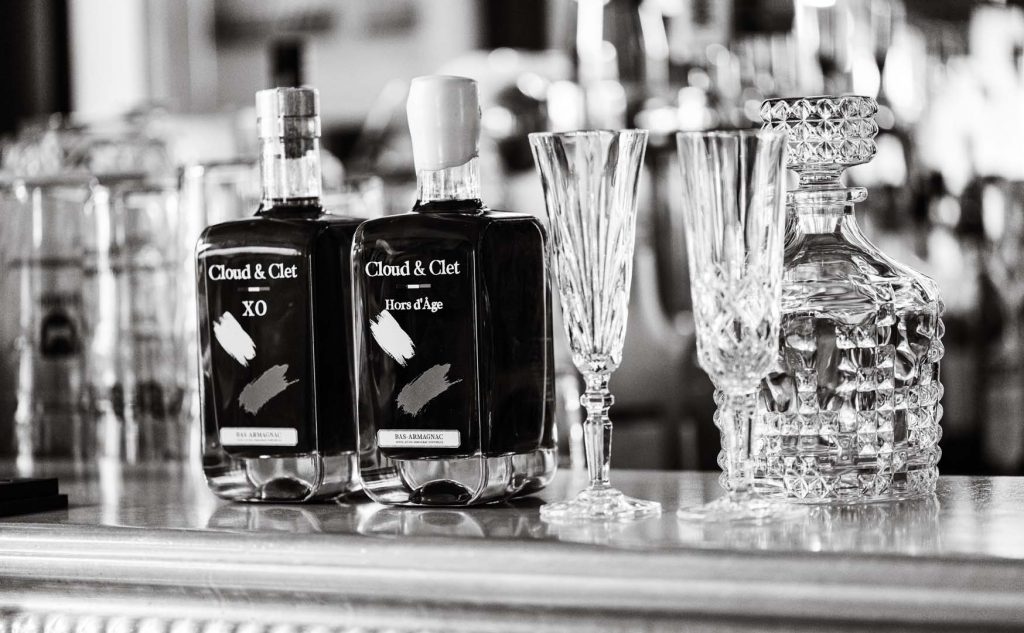
Discover Cloud & Clet Bas-Armagnac
Cloud & Clet comes from the Domaine de M., a family estate in Mauléon-d’Armagnac, in the heart of Grand Bas-Armagnac, on sables fauves soils. We handle every step, from vine to bottle, and distill on site in our own continuous Armagnac still. Our VSOP, XO, Hors d’Âge and vintages are 100% Baco. Explore our craft and our collections, from Blanche to vintages.

