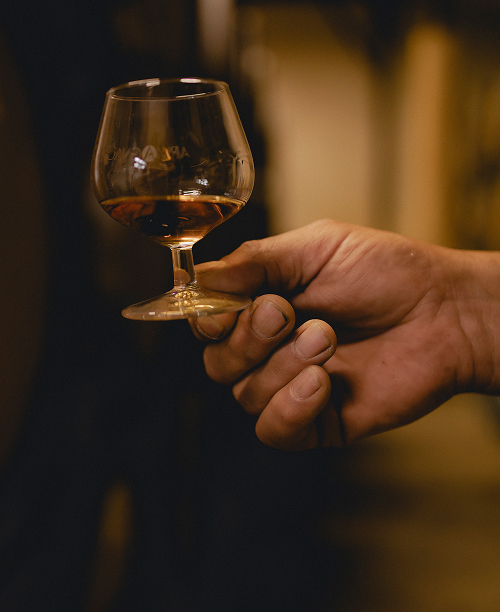
Armagnac is tasted from a tulip-shaped glass, at room temperature, in a small pour and at an unhurried pace: first the color, then the nose in several stages, then a very small sip, and finally the empty glass. Depending on its age, it can also be served ice-cold, over ice or in a cocktail. Here is the method, step by step.
Which glass is best for Armagnac?
The glass matters as much as the temperature. Its shape decides what reaches your nose first: the aromas, or the alcohol.
The tulip glass: the taster’s choice
A rounded bowl, a rim that narrows, and ideally a stem, so your hand doesn’t warm the spirit by accident. The narrow opening gathers the aromas and channels the alcohol vapors so they sting less. It is the glass most often recommended. A standard ISO tasting glass, a Glencairn-style whisky glass or a small tulip-shaped white-wine glass all work well.
The snifter: for a slow after-dinner pour
The classic brandy snifter, or balloon glass, sits in the palm of your hand. Its wide bowl lets aromas escape faster and pushes the alcohol forward, so it suits an old Armagnac after dinner better than an analytical tasting. With a snifter, keep the pour small and your nose away from the rim.
| Glass | Pros | Cons | Best for |
|---|---|---|---|
| Tulip | Concentrates aromas, softens the alcohol | Small capacity | Any Armagnac, tasted neat |
| Snifter | Comfortable in hand, gentle warmth | Aromas disperse, alcohol more noticeable | Old Armagnac after dinner |
| Rocks glass | Room for ice | Not suited to close tasting | Blanche, VS, VSOP over ice or in cocktails |
What temperature should Armagnac be served at?
Aged Armagnac is served at room temperature, around 64 to 68°F (18 to 20°C). Cold “closes” the aromas: an XO poured from a chilly room will seem mute for a few minutes. If needed, the warmth of your hand through the glass is enough to wake it gently.
Blanche is the exception. It never sees a cask, its appeal is fresh fruit, and it is usually served ice-cold, straight from the fridge or even the freezer, where it will not freeze: at 40% ABV, its freezing point is well below the 0°F (−18°C) of a home freezer.
How much Armagnac should you pour?
For tasting, 2 to 3 cl (roughly ¾ to 1 oz) is plenty. A small pour leaves room for the aromas to gather above the liquid.
For reference, the US National Institute on Alcohol Abuse and Alcoholism defines a standard drink as 14 grams of pure alcohol, which is 1.5 oz of a 40% spirit. Armagnac is a spirit for slow, attentive tasting, best enjoyed in moderation.
How to taste Armagnac, step by step
1. The eye: color and legs
Tilt the glass over a white surface. Armagnac’s color moves from pale yellow to orange, amber and then mahogany as the spirit ages in oak. It should be clear and bright. Color is a clue, not proof: the appellation rules allow color adjustment with caramel. Blanche, for its part, is perfectly colorless.
Swirl the glass and you will see “tears” or “legs” form on the side. This physical effect comes from alcohol evaporating faster than water. It tells you about alcohol content and a little about texture, not about quality.
2. The nose, in several stages
- First nose, glass still. Bring the glass toward you without sticking your nose in, about an inch or two from the rim. The most volatile aromas come first: fruit, flowers, sometimes a hint of alcohol.
- Let it breathe. Leave the glass to rest for a few minutes. A young Armagnac opens quickly; an old blend or a vintage rewards more patience.
- Second nose, after a gentle swirl. A few turns of the wrist are enough. Deeper notes appear: cooked or candied fruit, vanilla, spice, oak.
- Third nose, a little later. The heaviest aromas rise last: prune, cocoa, tobacco and, in the oldest spirits, rancio.
A few drops of water, or not?
At 40% ABV, the minimum strength set by the appellation rules, water is usually unnecessary. It can help open up a cask-strength Armagnac, bottled at its natural, higher proof. The method: one or two drops of still, low-mineral water at room temperature, then nose again. The most telling test: split a small pour between two glasses, one with water and one without.
3. The palate
A very small sip is enough. The first one gets your palate used to the alcohol; the second reveals the spirit. Hold it in your mouth for a few seconds, let it coat your tongue, then note the attack (supple, lively, warm), the texture (round, broad, silky) and the balance between fruit, oak and alcohol. The alcohol should carry the aromas without crushing them.
4. The finish
Once you have swallowed, or spat in a professional tasting, notice how long the flavors linger. French tasters measure this length in caudalies, one caudalie being one second. A long, evolving finish is one of the most reliable signs of quality.
5. The empty glass, until the next day
An empty glass still has something to say. Once the alcohol has evaporated, it gives off notes of vanilla, wood, dried fruit or cocoa. You can leave it on the table overnight: an old Armagnac leaves a surprisingly lasting scent, which says a lot about its depth.
Armagnac tasting vocabulary
- Color (the French say “robe”): the hue and brilliance of the spirit.
- Legs, tears: the streaks that form on the inside of the glass after swirling.
- Attack: the first impression on the palate.
- Oaky, integrated oak: the imprint of the oak cask; “integrated” when it blends in without dominating.
- Rancio: a complex aroma of very old Armagnacs, often after twenty years or so in oak, reminiscent of walnut, dried fruit, forest floor, leather or mushroom. The appellation rules list it among the aromas of aged spirits.
- Cask strength (in French, “brut de fût”): Armagnac bottled without reduction, at its natural strength.
- Reduction: gradually lowering the strength with water before bottling.
How to serve Armagnac by age
The age on the label, which refers to the youngest spirit in the blend, is your best serving guide. Our guide to Armagnac age statements explains each one.
- Blanche: ice-cold, neat, topped with tonic or in a cocktail. It is all about crisp fruit (more in our Blanche Armagnac guide).
- VS (at least one year in oak under the appellation rules): over ice, in long drinks or in cocktails (see our Armagnac cocktail recipes). Ours spends at least three years in French oak casks.
- VSOP (at least four years): neat, over a single ice cube or in a cocktail. The Armagnac trade body considers a fruity, lightly oaked VSOP perfect over ice.
- XO, Hors d’Âge (ten years and older) and vintages: neat, no ice, after dinner or with dessert. This is where tasting in stages really pays off.
Common mistakes
- Warming the glass over a flame. The old ritual of passing a snifter over a candle is best forgotten: heat speeds up evaporation, the alcohol floods your nose and the most delicate aromas vanish. The palm of your hand is enough.
- An oversized glass. In a big snifter or a red-wine glass, the aromas dilute and the alcohol takes over.
- Diving in nose-first and swirling hard. The first approach should be gentle, or the alcohol overwhelms your sense of smell.
- Ice in an old Armagnac. Cold and dilution erase what makes an XO or a vintage worth tasting.
- A tired palate. Coffee, mint or very spicy food just before will skew your perception.
Frequently asked questions
Should you warm Armagnac in your hand?
Not at room temperature. If an old Armagnac seems closed, cupping the glass in your palm for a few moments helps it open.
Is Armagnac served before or after a meal?
Both. Younger styles (Blanche, VS, VSOP) work as an aperitif, over ice or in a cocktail; older ones are usually served after dinner or with dessert. Our Armagnac food pairing guide goes into detail.
How long should Armagnac breathe in the glass?
A few minutes for a young Armagnac, longer for an old blend or a vintage, which keeps evolving in the glass throughout the tasting.
Where to start
Nothing teaches like a comparison. Served side by side in small measures, in two tulip glasses, our VSOP and our XO, both 100% Baco Bas-Armagnacs distilled in the estate’s own Armagnac still, show what years in oak change, on the nose and on the palate.